Ask five people in your business what makes you different, and you may get five different answers. That inconsistency shows up in your website, ads and sales conversations, and customers notice.
A brand positioning statement fixes the problem at its source. It is a short internal statement that defines who you serve, what you offer and why you are the better choice. Here is how the Twastia.io team approaches writing one that actually guides decisions.
What a Brand Positioning Statement Is
A positioning statement describes the place you want your brand to hold in customers’ minds. It is written for your team, not for customers, so it can be plain and direct.
It is not a tagline, mission statement or slogan. Those may grow out of your positioning, but the positioning statement is the strategic foundation behind them.
The Four Building Blocks
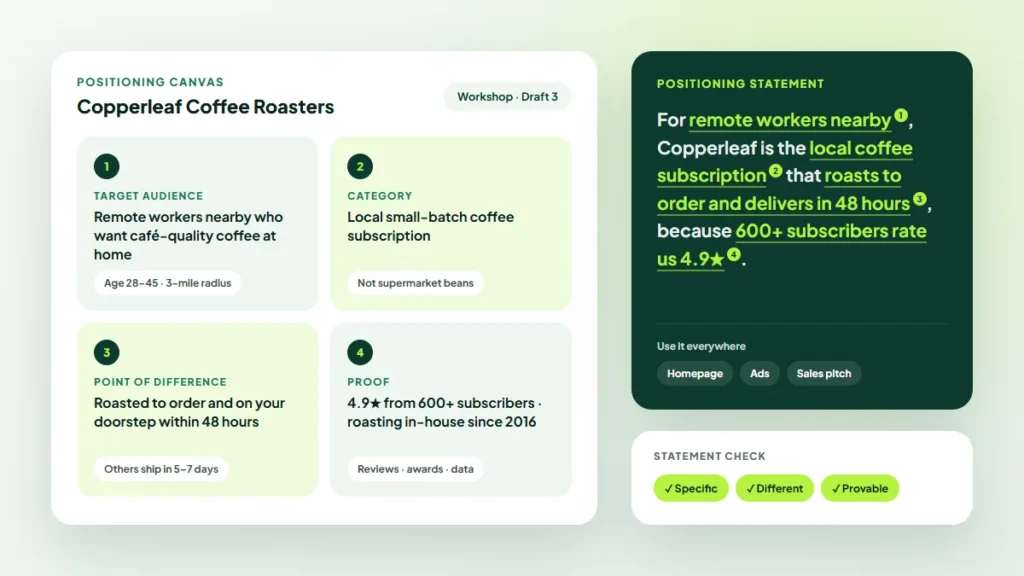
Most positioning statements combine the same core elements. Work through each one before writing the final sentence.
1. Target Customer
Describe the specific group you serve best. “Small businesses” is too broad; “owner-led home services companies that rely on local leads” gives your team something to work with.
2. Category or Frame of Reference
State what kind of business you are, in terms customers understand. This tells people what to compare you with.
3. Key Benefit
Name the most important result or experience you deliver. Choose one, not five. It should matter to your target customer and be something competitors do not claim as convincingly.
4. Reason to Believe
Back up the benefit with proof: a process, a guarantee, a specialization or a capability you can genuinely demonstrate. Without this, the benefit is just a claim.
A Simple Positioning Statement Formula
Once you have the building blocks, combine them into one or two sentences. A common structure follows this order:
- For a specific target customer
- who has a particular need or problem,
- your brand is the category option
- that delivers a key benefit,
- because of a credible reason to believe.
For example, a bookkeeping firm might write: “For owner-managed construction companies that struggle to track job costs, our firm is the bookkeeping partner that shows the profit on every project, because we specialize in construction accounts and report monthly by job.”
The example is illustrative, but notice how specific it is. Every part narrows the audience or sharpens the promise.
Avoid words any competitor could claim, such as “quality,” “trusted” or “customer-focused.” If a phrase would fit on a rival’s website unchanged, replace it with something only you can say.
How to Write Yours Step by Step
- Talk to customers. Ask your best customers why they chose you and what nearly made them go elsewhere.
- Map competitors. Note how competitors describe themselves, and look for gaps no one owns.
- Draft several versions. Write three or four variations that emphasize different benefits.
- Test them internally. Ask your team which one best matches what you deliver every day.
- Pick one and refine it. Remove vague words until every phrase earns its place.
Signs Your Positioning Statement Works
- It is specific enough that some customers are clearly not a fit.
- A competitor could not use it without changing important details.
- Your team can explain it in their own words.
- It helps you say no to projects, channels or messages that do not fit.
- Every claim in it is true and can be demonstrated.
Put Your Positioning to Work
A positioning statement only creates value when it shapes what customers see. Use it to guide your homepage headline, service page copy, ad messaging and sales conversations.
It should also inform your visual identity and voice. Our guide to creating brand guidelines for a small business shows how to turn positioning into practical rules your whole team can follow.
Local listings matter too. Your Google Business Profile description is a natural place to express what sets you apart, as our Google Business Profile optimization guide explains. Keep it factual and within Google’s guidelines for representing your business.
Frequently Asked Questions
How long should a positioning statement be?
Usually one or two sentences. If it needs a full paragraph, it is probably trying to cover too many audiences or benefits.
Should customers see my positioning statement?
Not word for word. It is an internal tool. Customers see its effect in your headlines, messaging and the way you describe your services.
How often should I revisit it?
Review it when you add services, enter new markets or notice that your messaging no longer matches the customers you attract.
For more on identity, messaging and rebrands, explore our branding guides.
Build a Brand With a Clear Position
Clear positioning makes every other marketing decision easier. If you want help defining it and carrying it through your identity and website, explore the branding services from Twastia.io or learn more about how we work.
Unsure whether your positioning is clear enough? Request a free growth audit, and Twastia.io will review how your brand comes across online and where your message could be sharper.