Look at your website, your last social post, your business card and your latest proposal side by side. If they feel like they came from four different companies, you are not alone. Brands that grow without a plan often drift in small ways until they stop looking consistent.
Brand guidelines fix this. They are a practical rulebook that keeps your look and voice the same everywhere, whoever is creating the material. This guide from Twastia.io explains what to include and how to create brand guidelines for a small business without a big agency budget.
Why Small Businesses Need Brand Guidelines
Consistency makes a business easier to recognize and easier to trust. When customers see the same colors, fonts and tone across every touchpoint, your brand starts to feel established.
Guidelines also save time. Freelancers, new staff and partners can produce on-brand work without guessing or waiting for your approval on every detail.
What to Include in Your Brand Guidelines
You do not need a hundred-page manual. A clear, focused document covering the essentials will do more good than a long one nobody reads.
1. Brand Foundations
Start with the “why” behind the visuals. In a page or less, describe what your business does, who it serves and what makes it different.
- Mission: what you do and for whom, in one or two sentences.
- Positioning: the specific reason customers should choose you over alternatives.
- Brand values: three to five principles that guide decisions, each with a short explanation.
- Audience: a brief description of your ideal customers and what they care about.
2. Logo Usage
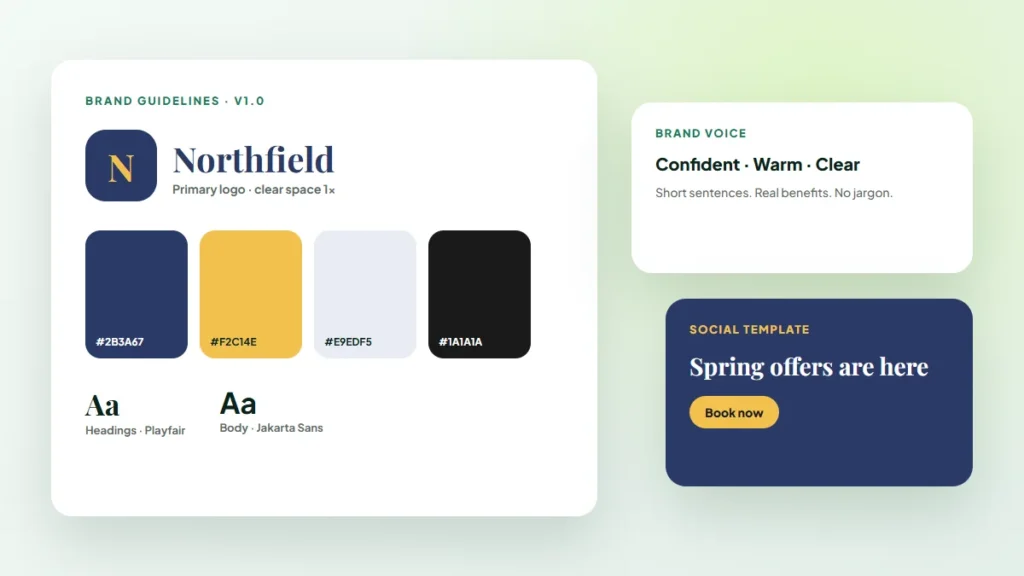
Show every approved version of your logo: primary, secondary or stacked, icon only, and light and dark versions. Explain when to use each one.
Define clear space around the logo and a minimum size so it stays legible. Then show a few examples of what not to do, such as stretching, recoloring, adding effects or placing it on busy backgrounds.
3. Color Palette
List your primary and secondary colors with their exact values: HEX for web, RGB for screens and CMYK or Pantone for print. Without exact codes, colors drift quickly.
Explain how colors are used, not just what they are. For example, note which color is reserved for buttons and calls to action, and which works for backgrounds.
Check that text and background pairings meet the WCAG minimum contrast guidance, so every color combination stays readable.
4. Typography
Choose a heading font and a body font, and specify weights and sizes for headings, body text and captions. Include a fallback font for situations where your main font is not available, such as email.
5. Imagery and Graphic Style
Describe the kind of photos and illustrations that fit your brand. Are they bright or moody, candid or posed, people-focused or product-focused?
Include a few example images that fit and a few that do not. Visual examples are far easier to follow than written descriptions alone.
6. Brand Voice and Messaging
Your words are part of your brand, too. Define how you sound with a handful of voice traits, such as “clear, warm and confident,” and show what each trait looks like in practice.
- Words and phrases you use often, and ones you avoid.
- Your tagline and a short, approved description of the business.
- Formatting preferences, such as how you write dates, numbers and your company name.
- Before-and-after examples that turn off-brand copy into on-brand copy.
7. Real-World Applications
Close the document with examples of the brand in use: a social post, a web page section, an email signature and a printed item. These show how all the rules work together and give people templates to start from.
How to Create Your Brand Guidelines Step by Step
- Audit what you already have. Gather your logo files, colors, fonts and recent materials, and note where things are inconsistent.
- Make decisions. Choose the versions you will keep. Avoid trying to preserve every variation that has crept in over time.
- Write the foundations. Agree on mission, positioning and values with the people who run the business.
- Document the visual rules. Add logo, color, type and imagery guidance with exact values and examples.
- Define your voice. Review your best-performing emails or pages and describe what makes them work.
- Package and share it. Save it as a PDF or shared online page, along with a folder of approved logo files and templates.
- Review it regularly. Revisit the guidelines when you add services, enter new markets or notice inconsistency creeping back.
Make the Guidelines Easy to Follow
The best guidelines are the ones people actually use. Keep the language plain and the layout scannable, and lead with the rules people need most often.
Templates do a lot of the heavy lifting. Ready-made social graphics, presentation slides and document layouts make the right choice the easy choice.
Finally, name one person as the owner of the guidelines. They answer questions, approve exceptions and keep the document and files up to date, so the rules do not quietly fall out of use.
Signs Your Brand Needs More Than Guidelines
Sometimes documenting your current brand reveals a bigger issue. If your logo no longer reflects what you offer, or your positioning sounds like every competitor, you may need a refresh, starting with a sharper brand positioning statement, before you write the rules.
Our branding articles cover positioning, visual identity and when a rebrand makes sense. A well-structured website is also part of the picture, so it is worth reading our website redesign checklist before you update your site.
Frequently Asked Questions
How long should brand guidelines be?
Long enough to answer the common questions, short enough to read in one sitting. For many small businesses, a focused document of a dozen or so pages is plenty.
Is a brand style guide the same as brand guidelines?
The terms are often used interchangeably. Some teams use “style guide” for the visual rules only, while “brand guidelines” also cover positioning and voice.
Can I create brand guidelines myself?
Yes, especially if your visual identity is already solid. A specialist helps most when decisions are unclear or the brand itself needs work.
Build a Brand People Recognize
Brand guidelines turn good intentions into consistent results across your website, ads, social media and sales materials. If you want help defining your positioning or building a full identity system, explore the Twastia.io branding services.
Not sure whether you need guidelines, a refresh or a full rebrand? Request a free growth audit, and Twastia.io will review how your brand shows up online and recommend the most practical next step.